An AI agent reaching the payment step is not merely another browser session. The merchant must know who initiated the request, what the customer approved, which total is authoritative, whether a retry is a duplicate, and how the order can be explained, refunded, or disputed later.
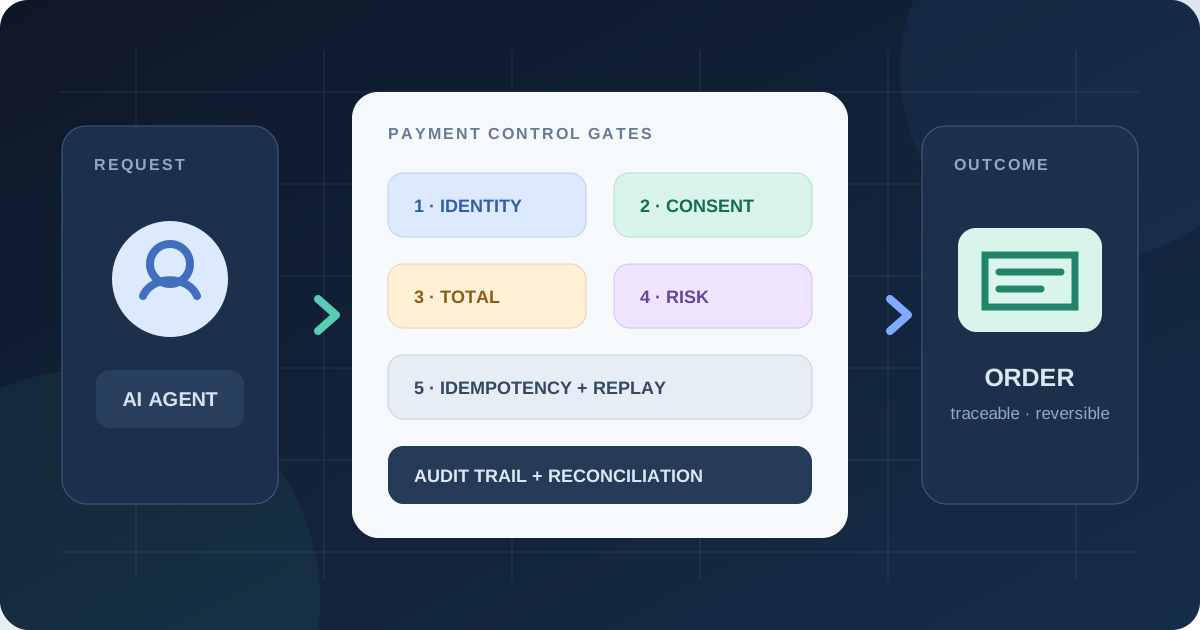
Keep the merchant backend authoritative. Verify the channel, recalculate products and totals server-side, bind payment authority to a seller, amount and expiry, make every write idempotent, and preserve an audit trail from customer approval to refund. A protocol can carry these signals; it does not replace the operating controls around them.
Agentic payment readiness is now an operational question
Infrastructure is moving from demos toward controlled transactions. In June 2026, Mastercard and PrivatBank announced Ukraine's first payment executed by an AI agent through Agent Pay. Mastercard separately said all its European issuers were enabled at network level for Agent Pay, while real-world pilots and merchant availability continue to develop. Visa's Trusted Agent Protocol now documents how a merchant can recognise a payment-network-approved agent through signed, time-bound messages.
Demand is not the same as universal availability. McKinsey's 2026 European consumer research found AI use much stronger for product research and comparison than for checkout; trust fell as actions became harder to reverse or audit. OpenAI's official checkout specification likewise says the standard is open, while Instant Checkout in ChatGPT is currently limited to approved partners.
The useful response is therefore a narrow readiness programme. Improve the controls that also protect marketplace, mobile-app and API orders today. Integrate a specific agentic channel only after confirming geography, payment provider, merchant eligibility, commercial terms and measurable demand.
Use seven gates, not one “AI order” flag
| Gate | Question | Evidence |
|---|---|---|
| Channel | Which agent or platform sent this? | Verified signature, key, timestamp, request ID |
| Intent | What did the customer approve? | Consent reference, scope, amount, seller, expiry |
| Commerce | Can these items be sold on these terms? | Server-side catalog, stock, tax, delivery and policy result |
| Payment | Can this credential fund this exact order? | Token limits, provider response, authentication state |
| Risk | Should the order pass, step up or stop? | Fraud decision and reason, velocity, account evidence |
| Write | Has this operation already succeeded? | Idempotency record and immutable order identifier |
| Aftercare | Can support reconstruct and reverse it? | Timeline, receipts, fulfilment events, refund trail |
Do not collapse these into “trusted agent = trusted order.” A valid channel signature can prove origin and message integrity; it does not prove stock, price, customer entitlement, payment success, low fraud risk or a valid shipping address.
Keep price, inventory and order state on merchant rails
Treat item IDs, quantities, coupon codes, shipping choices and customer data from an agent as requested inputs. Resolve the IDs against the current catalog, enforce quantity and market rules, reserve stock under a clear timeout, calculate tax and delivery, and return the complete current state. The customer should approve the merchant-calculated total—not a number copied from an earlier conversation.
OpenAI's current Agentic Checkout Spec follows this pattern: create and update calls return a rich cart with line items, taxes, fees, fulfilment choices, totals, messages and errors. The merchant completes the checkout and creates the order on its existing stack. That separation is valuable beyond one provider.
- Reject unknown or retired SKUs; never substitute silently.
- Recalculate discounts and eligibility at every material update.
- Expire reservations and quotes; show when a total has changed.
- Return structured errors such as out of stock, payment declined or additional authentication required.
- Do not mark an order paid because the agent says payment succeeded; use the payment provider's authoritative result.
Verify the channel, message and declared intent
Give every agentic channel separate credentials, keys, permissions, limits and monitoring. Verify the exact signed payload before parsing it into business actions. Check timestamp freshness, expected host and path, key status, algorithm, signature and—where the protocol provides one—a nonce. Reject missing or ambiguous verification data.
Visa's Trusted Agent Protocol uses HTTP message signatures and describes separate signals for agent recognition, consumer recognition and payment. This is a useful conceptual boundary: proving the calling agent is approved is not the same as proving which customer it represents or what payment authority exists.
Rotate keys without downtime, cache public keys only for their allowed lifetime, and define behaviour when the key service is unavailable. A safe failure may be to offer a conventional human checkout, not to accept unsigned automation. Log verification outcome and identifiers, but never log raw card credentials, authentication secrets or unnecessary personal data.
Bind payment authority to this seller and purchase
A reusable card credential with broad authority is a poor hand-off between an agent and a merchant. Prefer a provider-supported token whose use is constrained to the intended seller, currency, maximum amount and expiry, with the underlying credential kept away from the merchant integration wherever possible.
Stripe's Shared Payment Token documentation provides one concrete implementation: an agent grants the seller a time-limited token with amount, currency and seller limits; the seller uses it in the normal PaymentIntent flow. Stripe documents lifecycle events for use, revocation and expiry. OpenAI's checkout spec says merchants keep their existing PSP and settlement process and accept a delegated token only when applicable.
Token limits are a floor, not the whole control system. Before authorization, compare the final merchant total with the customer-approved total and token ceiling. Decide how tips, substitutions, partial fulfilment, recurring payments, delayed capture and post-order adjustments work. Require fresh approval when a material term exceeds the original scope. Never convert a single-use mandate into stored recurring authority by default.
Design every write for retries, duplicates and replay
Agentic flows cross several systems: agent, commerce API, payment provider, inventory, tax, fulfilment and webhooks. Timeouts are inevitable. The dangerous case is not a clean error; it is a successful charge whose response was lost, followed by a retry.
Require an idempotency key on create, update, complete, cancel and refund operations. Scope it to channel and operation, store the request fingerprint and durable result, and return the earlier result when the same request repeats. If the same key arrives with a different material payload, reject it. Keep the record longer than the maximum retry and dispute window appropriate to the operation.
Idempotency stops duplicate processing; replay protection rejects a captured signed request outside its valid context or time. Use both. Make webhook consumers idempotent too, tolerate out-of-order delivery, and reconcile from provider state rather than assuming every event arrived once and in order.
Preserve fraud, authentication and customer control
Do not place agentic orders on a blanket allowlist. Pass available device, customer, token and channel risk signals to the existing fraud engine. Apply velocity limits by customer, agent, account, address, product and payment instrument. Keep 3-D Secure or other step-up authentication paths working where the issuer or risk policy requires them.
Define manual-review outcomes the agent can represent accurately. A review state is not a confirmed order. High-resale items, gift cards, unusual address changes and repeated near-limit attempts may need tighter policy. Conversely, blocking every automated request at the WAF can erase legitimate demand; identify verified commerce traffic before applying generic bot rules.
The customer needs a readable final summary, clear merchant identity, delivery and return terms, a deliberate confirmation moment, and a route to a human. Preserve accessibility and local consumer rights. For legal, PCI, privacy, tax and sanctions conclusions, use qualified specialists and the requirements of your acquirer and markets.
Reconcile payment, order and fulfilment—not just API status
Create one correlation chain across channel request, checkout session, customer approval, payment authorization, order, capture, fulfilment, cancellation and refund. Support should be able to answer: what the customer approved, what was charged, which agent acted, what changed, what was delivered and how to reverse it.
Reconcile provider settlements against orders daily. Alert on paid-without-order, order-without-payment, duplicate capture, stale authorization, shipment after cancellation, refund mismatch and webhook backlog. Track approval-to-completion, payment declines, step-up rate, manual reviews, duplicates prevented, cancellations, returns, disputes, support contacts and contribution margin by agentic channel.
Measure incrementality carefully. A new channel may claim an order that existing search or direct traffic would have produced. Use stable channel identifiers and the existing AI-commerce attribution framework; compare net revenue and operating cost, not checkout starts.
A 14-day readiness pilot
Start in a test environment with one product class and one payment method. Then use a low-value, tightly limited live cohort if the provider and internal owners approve. The deliverable is a control matrix, sequence diagram, test evidence, reconciliation report, incident rollback and named owners—not a demo video.
Frequently asked questions
Can any merchant enable ChatGPT Instant Checkout?
No. OpenAI says building with ACP is open, but Instant Checkout in ChatGPT is currently available to approved partners. Confirm current eligibility and markets in official documentation.
Must a merchant change payment providers?
Not necessarily. The OpenAI checkout specification keeps payment processing and settlement on the merchant's existing rails. Delegated-token support depends on the channel, PSP and merchant arrangement.
Does a verified AI agent eliminate fraud checks?
No. Verified origin is one signal. Validate price, inventory, mandate, token limits, customer authentication and transaction risk independently.
What prevents duplicate AI orders?
Durable idempotency on every state-changing endpoint, combined with provider reconciliation. Reusing a key must return the prior result; the same key with a changed payload must fail.
What should a small store build first?
Reliable server-side totals, stable order states, provider webhooks, idempotency, refund handling and a complete support timeline. Do not build a speculative protocol adapter before those basics work.
Sources and verification date
Verified 11 September 2026 against official OpenAI Agentic Checkout documentation, Visa Trusted Agent Protocol specifications, Stripe Shared Payment Token documentation, and the Mastercard–PrivatBank transaction announcement. Market context uses Mastercard's June 2026 European update and McKinsey's European consumer research. Specifications, availability and provider requirements can change; recheck before implementation.
Rendframe can map the checkout state machine, implement signed and idempotent endpoints, connect payment and order events, build reconciliation, and run failure testing. Start with the AI shopping readiness audit, explore agentic-commerce systems, or send one anonymised checkout sequence for a focused review.