A parcel with five identical T-shirts can attract €3 of EU customs duty. A parcel with one T-shirt and one watch can attract €6. Since 1 July 2026, the old duty-free threshold for low-value ecommerce imports has gone, but the new charge is not simply “€3 per parcel” or “€3 per product.” It follows the goods lines on the customs declaration.
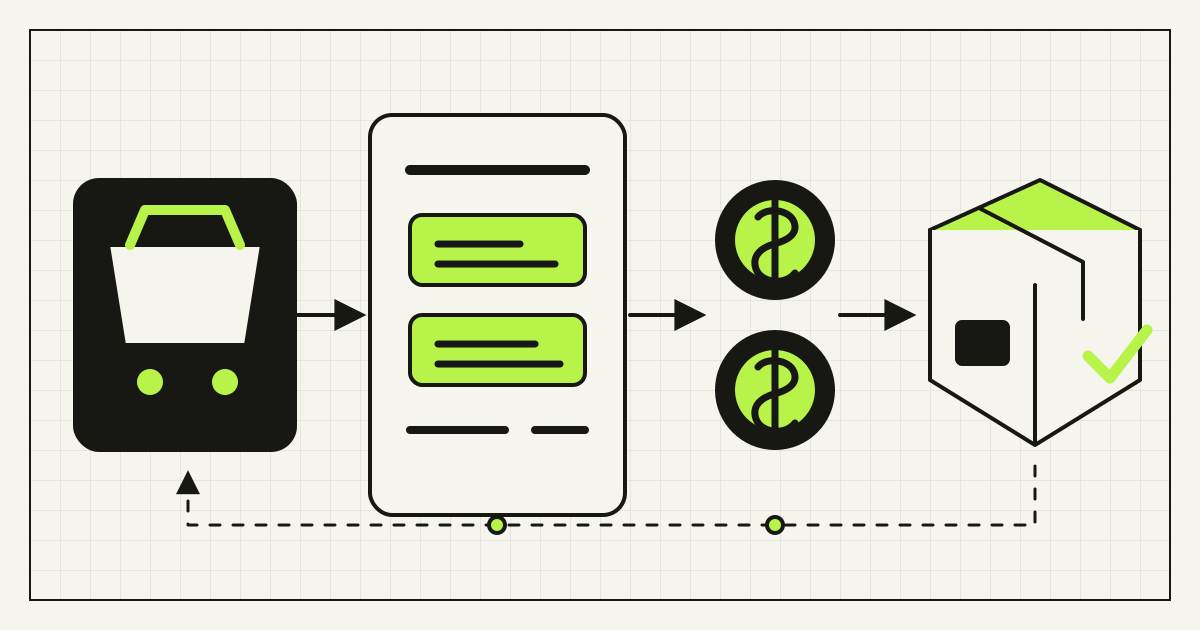
For non-EU merchants selling goods worth up to €150 to EU consumers, the immediate job is to establish who declares the goods, how many declaration lines each shipment creates, how the duty is funded, and whether the buyer sees a reliable landed price. Do not patch checkout before your carrier, marketplace, IOSS intermediary, and catalog owner agree on those four points.
This guide is an operational implementation framework, not customs, tax, or legal advice. Product origin, category, destination, sales channel, VAT route, and representation can change the answer. Confirm the treatment with the party lodging your declaration.
What changed on 1 July 2026
Council Regulation (EU) 2026/382 removed the customs-duty relief previously available to consignments with an intrinsic value up to €150. A temporary flat duty of €3 per customs goods item now applies to qualifying distance sales imported into the EU. The measure runs from 1 July 2026 until 1 July 2028, subject to the transition described in the legislation and future assessments.
The European Commission’s operator guidance says the intended scope covers goods in consignments up to €150 sold remotely to EU consumers, whether the VAT route is IOSS, Special Arrangements, or the standard procedure. The rule concerns goods outside the EU at the time of sale and dispatched or transported by or on behalf of the supplier. Stock already released into free circulation in the EU is a different flow.
Do not merge this duty with the proposed Union handling fee. The duty is already in force. The amount and start date of the separate handling fee were still to be determined when the Commission’s VAT addendum was revised on 21 August 2026; it cannot safely be coded as a final charge yet.
What “€3 per item” actually means
In everyday language, an item means one unit. In the customs guidance, it means one or more goods in a consignment sharing the same tariff classification, description, and, where the declaration requires it, origin. Existing customs IT applies the €3 duty per declaration line, regardless of the number of physical units recorded on that line.
| Shipment | Likely goods lines | Illustrative duty |
|---|---|---|
| 5 identical T-shirts, same classification and origin | 1 | €3 |
| 1 T-shirt + 1 watch | 2 | €6 |
| 2 products ordered together but dispatched separately | Calculated per separate consignment | Depends on each declaration |
| Goods with different classifications forced into one line | Grouping is not allowed for this temporary duty | Correct lines required |
The official customs guidance for Member States and trade also defines intrinsic value as the goods’ price, excluding separately stated transport and insurance and identifiable taxes or charges. That definition determines whether the consignment is within €150; it is not a licence to split orders artificially. Separately ordered or shipped parcels and anti-abuse rules complicate consolidation.
Your storefront therefore cannot calculate the duty reliably from SKU quantity alone. It needs the customs classification, description, origin where relevant, and the actual shipment grouping that the declarant will use.
Map IOSS, VAT, and the declarant before changing checkout
IOSS still exists. It is the scheme for collecting destination-country VAT at checkout on eligible imported distance sales, not a mechanism that remits the €3 customs duty. According to the Commission’s revised VAT addendum, IOSS goods are exempt from import VAT, so no VAT is due on the €3 at import and the duty is not included in the VAT base at the moment of sale.
Under Special Arrangements or the standard import procedure, import VAT is due and the €3 duty forms part of the VAT taxable amount. In Special Arrangements, the carrier or postal operator collects import VAT from the customer. This is one reason identical baskets can produce different customer experiences depending on the route.
- Write down the seller of record. Direct store, marketplace, and social-commerce sales may assign responsibilities differently.
- Name the declarant. Record the seller, marketplace, carrier, postal operator, importer, or representative that lodges the customs declaration and incurs the customs debt.
- Confirm the VAT route. IOSS, Special Arrangements, and standard procedure have different VAT timing and customer impact.
- Confirm the money route. Agree who advances the duty, how the merchant is charged, and which report proves the final amount.
- Document the delivery promise. Decide whether the order is delivered with charges settled or whether a residual payment can reach the customer.
The Commission says the declarant is responsible for paying the duty; only residual national cases should put that role on the consumer. Commercially, the seller can still reflect the cost in product or shipping economics. The critical control is that your wording, checkout total, carrier service, and actual border process tell the same story.
For Ukrainian goods, preferential origin is not automatic
A product shipped from Ukraine is not necessarily of Ukrainian preferential origin. Origin depends on product-specific rules and sufficient production, not the sender’s address or a “Made in Ukraine” field alone. The EU–Ukraine trade agreement can reduce tariffs for qualifying products with the correct proof, but the new temporary-duty guidance attaches specific procedural conditions to its preference exception.
The Commission summary says goods benefiting from preferential trade agreements or customs-union measures can be excluded where VAT was not collected through IOSS and the goods are declared using the full H1 data set. That may trade a €3 line charge for a more demanding declaration and VAT/customer flow. It is not automatically the cheaper operational route.
Use the Commission’s Access2Markets and ROSA tools to investigate the tariff code, origin rule, proof, taxes, and destination formalities, then validate the chosen route with your customs intermediary. Never claim preference merely because an order leaves a Ukrainian warehouse.
Change the commerce system, not just the price
A robust implementation has one customs-ready product record and one shipment calculation used by checkout, warehouse, carrier integration, finance, and support.
customs_product
  sku + variant_id
  hs6_code + description
  country_of_origin + evidence_status
  intrinsic_value_source
  product_identifier
  restricted_or_excise_flags
  last_reviewed_at + owner
Product identifiers deserve attention now: the Commission guidance makes them voluntary from 1 July and mandatory from 1 November 2026 where the new requirement applies. Confirm which identifier type your tariff code requires and whether the carrier API can carry it before treating a generic SKU as sufficient.
- Enrich the catalog. Resolve missing and conflicting HS codes, descriptions, origin, and evidence at variant level.
- Calculate after destination and fulfilment are known. A cart estimate is provisional until the system knows the EU destination, ship-from location, parcel split, and declarant route.
- Group by customs rules. Count declaration lines, not units or storefront line items. Preserve the composition sent to the carrier.
- Show the landed-price promise early. EU consumers must receive clear total-price information. Do not reveal an unavoidable import amount only after payment.
- Pass structured data to logistics. Avoid free-text descriptions such as “gift,” “parts,” or “accessories.” Validate rejected and truncated carrier fields.
- Version the rules. Store effective dates and calculation versions so finance can reproduce why an order showed and incurred a given amount.
The article on GPSR product-page data covers safety operators, identifiers, and warnings. Reuse the governed catalog layer, but do not confuse safety identity with tariff classification or proof of origin.
Recalculate contribution margin by basket composition
A €3 charge looks small until low-priced mixed baskets create several lines. Model it below gross margin, together with fulfilment, shipping subsidy, payment cost, marketplace fees, returns allowance, and support. Use actual declaration files, not the theoretical number of storefront products.
Contribution after import = revenue excluding collected taxes − product cost − fulfilment − shipping subsidy − payment and channel fees − duty funded by the business − expected returns and support.
Illustrative example only: a €42 basket produces €18.90 gross profit at a 45% gross margin. If fulfilment and subsidised delivery cost €5, payment and channel costs €1.50, and two customs lines cost €6, only €6.40 remains before returns, support, and overhead. A one-line basket would leave €9.40. The business decision may be a minimum order, bundles that share classification, EU-held stock, different delivery pricing, or exiting an unprofitable lane—not hiding the amount at the final click.
Do not let the duty distort product classification. HS codes and origin are compliance facts, not pricing levers. Optimize assortment and fulfilment only after classification is correct.
Reconcile delivery, returns, and support
The customs guidance allows repayment or remission under Union Customs Code conditions and describes specific return flows, but a customer return does not magically reverse every merchant ledger. Your declarant may need evidence of export, declaration references, and a timely claim. Small amounts can cost more to recover than they are worth.
- store the customs declaration and line references against the shipment and order;
- import the carrier’s assessed duty, adjustments, clearance status, and invoice;
- match estimated lines with declared lines and flag every difference;
- define when duty is recoverable, who files, the evidence required, and the minimum economical claim;
- give support a plain-language answer for “why is this €6?” and “will I pay on delivery?”;
- separate product refund, VAT correction, shipping, duty recovery, and goodwill in the ledger.
Track duty per order, variance between estimate and assessment, parcels held or refused, post-delivery charge contacts, contribution margin by lane, declaration rejection rate, and recovery value. A low checkout-error rate can hide a costly reconciliation problem.
A ten-day implementation plan
Use real representative orders: one repeated SKU, one mixed basket, one split shipment, one marketplace order, one direct IOSS order, and one return. Before expanding, require the checkout estimate, carrier declaration, assessed duty, customer promise, and finance entry to reconcile for each case.
Frequently asked questions
Is the EU duty €3 per product or per parcel?
Neither phrase is precise. It is €3 per goods item on the customs declaration. A goods item can contain several units sharing classification, description, and, where applicable, origin. Different goods lines in the same parcel each attract the duty.
Does the €3 duty apply when I use IOSS?
Yes, the temporary duty applies to eligible IOSS imports. IOSS remains the VAT simplification. Under the Commission’s current guidance, no VAT is charged on the €3 duty for IOSS goods and the duty is not remitted through the IOSS return.
Who pays the €3 customs duty?
The customs declarant incurs the payment responsibility—depending on the flow, this may be the seller, marketplace, carrier, importer, IOSS holder, or representative. Contractually determine who advances and ultimately bears the cost. Consumer collection should be residual, not an accidental surprise.
Are goods made in Ukraine exempt?
Not automatically. Preferential treatment requires qualifying origin, proof, and the correct declaration route. The Commission’s temporary-duty exception also has VAT and H1 conditions. Check the exact product and destination in Access2Markets and confirm with the declarant.
Is the EU handling fee another €3?
No. The €3 customs duty is in force. The proposed Union handling fee is a separate measure whose amount and application date were not final in the Commission’s 21 August 2026 VAT addendum. Monitor official guidance instead of pre-coding a rumour.
What should a small ecommerce seller do first?
Ask the carrier or marketplace for a written description of the declarant, VAT route, duty collection, required fields, and invoice report. Then test representative baskets against the actual customs declaration before changing prices across the catalog.
The border now reads your product data
The durable response to the new duty is not a €3 checkout toggle. It is a traceable chain from classified product to shipment line, customer price, carrier declaration, customs assessment, and finance record. When those records agree, the team can price honestly and see which EU lanes still work.
Rendframe can map the order-to-customs flow, repair catalog data, build landed-cost and checkout logic, connect carrier events, and create the reconciliation dashboard. Review our inventory-sync architecture, explore product engineering for commerce systems, or send us one anonymized order, carrier declaration, and invoice for a focused systems review.