An invoice attached to an email may be digital, but it is not necessarily an e-invoice. Across Europe, the operational requirement is moving toward structured, machine-readable invoice data that accounting systems and tax platforms can validate without retyping.
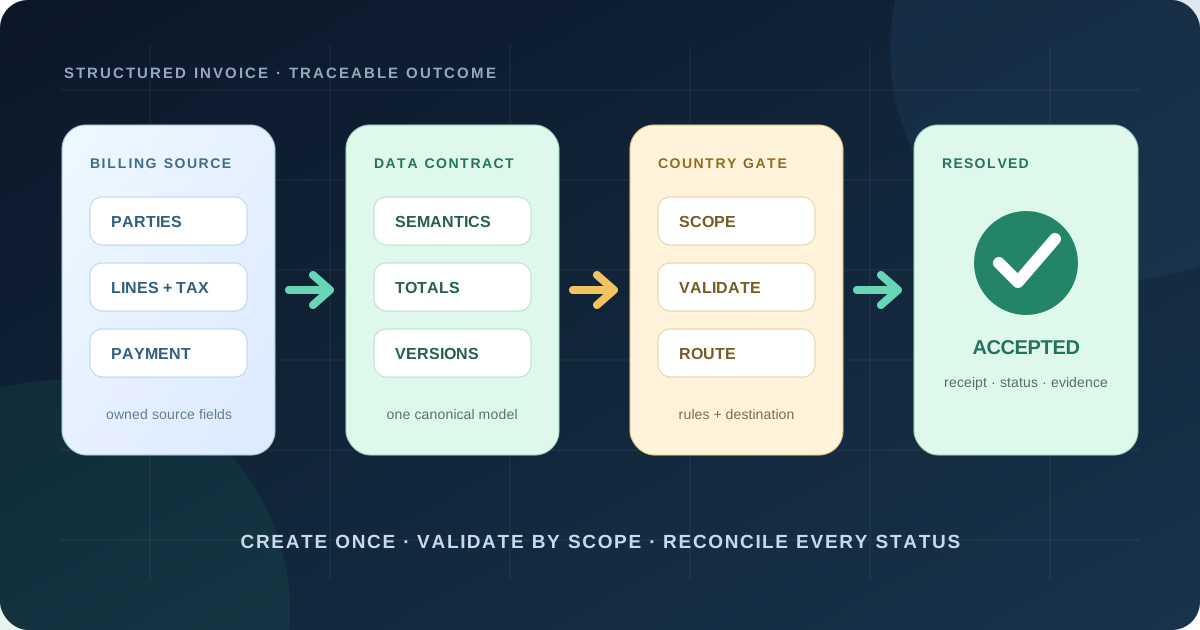
Do not start by buying a “Peppol connector.” Start with a country-and-transaction scope map, one canonical invoice data model, deterministic validation, delivery-state handling, and reconciliation back to accounting. A provider can transport the document; it cannot repair ambiguous tax logic or missing source data.
Why e-invoicing readiness matters in September 2026
France made its reform effective on 1 September 2026. The French tax authority says every business in scope must be able to receive electronic invoices from that date; large companies and intermediate-sized enterprises must also issue them and transmit the applicable transaction and payment data. French SMEs and microenterprises move to mandatory issuing on 1 September 2027. The authority is explicit that a scanned paper invoice, ordinary PDF, or email attachment does not meet the reform's definition.
This is one part of a wider, uneven transition. Belgium made domestic B2B e-invoicing mandatory from 1 January 2026 and uses Peppol for structured exchange. Poland's KSeF rollout began in February 2026, with receiving mandatory through the national system and staged issuing rules. At EU level, the VAT in the Digital Age package sets 1 July 2030 for digital reporting requirements tied to intra-EU B2B transactions. National obligations, channels, formats, exclusions, and dates still differ.
That variation is the real systems problem. A company may sell from Ukraine, bill a French establishment, buy from Belgium, and use one global ERP. “Supports XML” is not enough. The software must decide which rule set applies to each transaction, create complete data, send it by the accepted route, understand responses, and keep accounting and tax evidence aligned.
A PDF is a view; an e-invoice is processable data
The European Commission defines e-invoicing as issuing, sending, and receiving an invoice in a structured machine-readable format that permits automatic electronic processing. EN 16931 provides a semantic model: shared meanings and business rules for core invoice information. Syntaxes such as UBL or UN/CEFACT CII carry that meaning in a technical message. Country specifications may restrict the core model or add local rules.
Peppol is neither an invoice file nor a tax authority. It is an interoperability framework and delivery network through which certified service providers exchange documents using agreed specifications. Other countries operate central clearance or reporting platforms, such as Poland's KSeF. France requires businesses to use an approved platform for relevant exchanges. Separate these layers:
| Layer | Question it answers | Example |
|---|---|---|
| Business semantics | What does each field mean? | EN 16931 |
| Syntax/specification | How is the message represented? | UBL, CII, Peppol BIS/PINT, national CIUS |
| Transport/platform | How does it reach the receiver or authority? | Peppol access point, KSeF, French approved platform |
| Tax scope | Which transaction and reporting rules apply? | Domestic B2B, B2G, B2C, cross-border |
A human-readable PDF can still be generated as a rendering for review or customer service. It should be derived from the same approved data, not maintained as a second source of truth.
Build a transaction scope matrix before choosing software
Ask a tax adviser to confirm legal scope; ask engineering to make the confirmed decisions executable. Inventory flows by seller legal entity, establishment, buyer type, buyer country, tax registration, transaction type, currency, and channel. Include credit notes, prepayments, self-billing, exports, marketplace sales, and corrections—not only the common domestic invoice.
Seller entity | Buyer country | Buyer type | Flow | Tax rule owner
FR subsidiary | France        | B2B        | approved platform | France finance
BE subsidiary | Belgium       | B2B        | Peppol            | Belgium finance
UA company    | France        | B2B        | assess e-reporting | tax adviser
EU entity     | another EU MS | B2B        | current national rule; ViDA horizon | group tax
For every row, record the effective date, issuing obligation, receiving obligation, reporting obligation, accepted format, routing identifier, archive requirement, fallback rule, and named owner. Mark uncertain rows as unresolved. Do not turn an assumption into production tax logic merely because a vendor's country page looks confident.
Review the matrix quarterly and before entering a new country. The EU Commission's country factsheets are a useful starting point, but national tax authorities and enacted law govern. A common EU semantic core does not make rollout calendars identical.
Create one canonical invoice data contract
Your billing source should expose enough structured data to produce every required destination format without scraping the PDF. Define a versioned internal invoice object with at least:
- stable invoice and credit-note identifiers, issue and supply dates, and references to corrected documents;
- seller, buyer, tax-registration, legal-address, and electronic-routing identifiers;
- order, contract, project, delivery, and payment references needed for buyer matching;
- line quantity, unit, description, net price, allowances, charges, and rounding;
- tax category, rate, exemption or reverse-charge reason, taxable amount, tax amount, totals, currency, and exchange-rate evidence where applicable;
- payment means, account, due date, terms, and structured remittance reference;
- source record, jurisdiction decision, schema version, and transformation version.
Assign ownership field by field. CRM may own the legal customer identity, the contract system the purchase-order reference, the product catalog the unit code, and the tax engine the category. The invoicing integration may transform these values, but it should not invent them.
Validate in three stages: internal business rules; semantic and arithmetic rules; then the destination's current syntax and country rules. The Commission publishes machine-executable validation artefacts for EN 16931, while Peppol publishes release schedules and mandatory versions. Pin versions, test upgrades, and record which rules accepted each document.
Design the invoice as a lifecycle, not an export button
A robust flow needs explicit states. “Sent” is not “received,” and “accepted by a gateway” is not “booked by the buyer.” A practical state model is:
Use idempotency so a timeout and retry cannot create two fiscal documents. Store the immutable source snapshot, produced payload, human rendering, validation output, message identifier, platform receipt, timestamps, and subsequent status. Restrict who can cancel, replace, or issue credit. A rejected document should enter a work queue with its exact error, owner, deadline, and repair path.
Reconcile daily: invoice ledger to transmitted messages, platform responses, buyer acknowledgments where available, tax reporting, general ledger, and payment. Alert on missing sequence numbers, documents stuck in transit, duplicate business references, totals that diverge after posting, or status updates that no consumer processed.
Choose an integration route with evidence
Small companies may use a compliant accounting product directly. More complex businesses typically connect ERP or billing software to an approved provider or access point. Evaluate providers on the countries and transaction types they support today—not a logo wall.
Request a written capability matrix covering issuing, receiving, reporting, credit notes, attachments, buyer discovery, identity verification, validation rules, acknowledgments, archive/export, API limits, data location, incident response, exit, and historical-data portability. For France, confirm the platform appears on the tax authority's current approved list. For Peppol, confirm participant registration and supported document capabilities rather than assuming a directory search is exhaustive.
Keep jurisdiction and accounting decisions inside your controlled domain where possible. A transport provider should not silently convert an unknown tax category, round a total, replace an identifier, or downgrade a rejected structured invoice to email. Any permitted transformation needs a version, test, and audit record.
Test the failures that create expensive surprises
A successful “hello world” invoice proves only the happy path. Build fixtures for multiple tax rates, exemption, reverse charge, discounts across lines and header, prepayment, negative lines, foreign currency, credit note, missing purchase order, long text, non-Latin names, duplicate retry, invalid receiver, expired credential, provider timeout, delayed rejection, and correction after accounting close.
Run contract tests against current validators before each release. In a sandbox, verify payload, routing, response mapping, retry behavior, permissions, and observability. Then conduct a bounded pilot with real counterparties and reconcile both sides. Do not mass-enable a country until finance can answer: Which invoices left? Which arrived? Which failed? Which were reported? Which require action?
Measure first-pass acceptance, time from issue to delivery, rejection rate by cause, manual touches per invoice, time to repair, unmatched documents, duplicate attempts, and days-to-payment. The European Commission notes that the main operational benefit of structured invoices is automated reception, matching, booking, and payment scheduling; a PDF workflow keeps much of that work manual.
A 30-day e-invoicing readiness plan
- Days 1–5 — scope: list entities, countries, transaction types, volumes, systems, advisers, and effective dates. Freeze no assumptions.
- Days 6–10 — data: compare required terms with actual ERP, CRM, tax, order, and payment fields. Name every gap and owner.
- Days 11–15 — design: choose canonical schema, state machine, validation layers, provider route, evidence store, and reconciliation keys.
- Days 16–22 — build: implement mappings, deterministic totals, idempotent transmission, response ingestion, dashboards, and exception queues.
- Days 23–27 — prove: run negative fixtures and provider sandboxes; pilot representative invoices and credit notes with finance sign-off.
- Days 28–30 — operate: train owners, publish the exception runbook, set alerts, document version updates, and schedule the next scope review.
Compliance is jurisdiction-specific and changes. This is an implementation framework, not tax or legal advice. Confirm scope, retention, signatures, reporting, and correction rules with qualified advisers and the relevant authority.
Frequently asked questions
Is a PDF invoice an electronic invoice?
Not for regimes that require structured, machine-processable data. A PDF may be a useful visual copy, but France explicitly says an ordinary PDF or emailed document does not satisfy its new reform.
Is Peppol mandatory everywhere in the EU?
No. Peppol is widely used, including for Belgian B2B exchange, but countries use different networks, platforms, clearance models, specifications, and timelines. Confirm each transaction flow.
Does EN 16931 make one invoice valid in every country?
No. It gives a shared semantic core. Country rules and Core Invoice Usage Specifications can restrict or supplement it, and tax scope still depends on national law.
What should an ecommerce business change first?
Capture a reliable B2B identity and tax status, keep buyer and order references, define the invoice trigger after refunds and partial fulfilment, and separate B2B invoicing from consumer receipts.
Should we automate invoice approval with AI?
Use deterministic rules for legal fields, totals, schema, and routing. AI can assist classification or exception triage, but uncertain output should not silently alter a fiscal document.
Sources and verification date
Verified 15 September 2026 against the European Commission's ViDA timeline, e-invoicing definition and standard overview, and EN 16931 compliance guidance; France's effective reform guidance and official rollout dates; Poland's KSeF scope; the Commission's Belgium factsheet; and OpenPeppol's current specifications and release dates.
Rendframe can map billing data, design the canonical contract, integrate an approved provider, build validation and exception handling, and prove reconciliation. Review the invoice-processing controls, protect the dependency with a SaaS recovery plan, or send us one anonymized invoice flow and target-country list.