A Merchant Center error is usually the last visible symptom of a disagreement between your catalog, feed, product page, structured data, and checkout. Editing one item in Google may make the warning disappear today while the next catalog sync recreates it tomorrow.
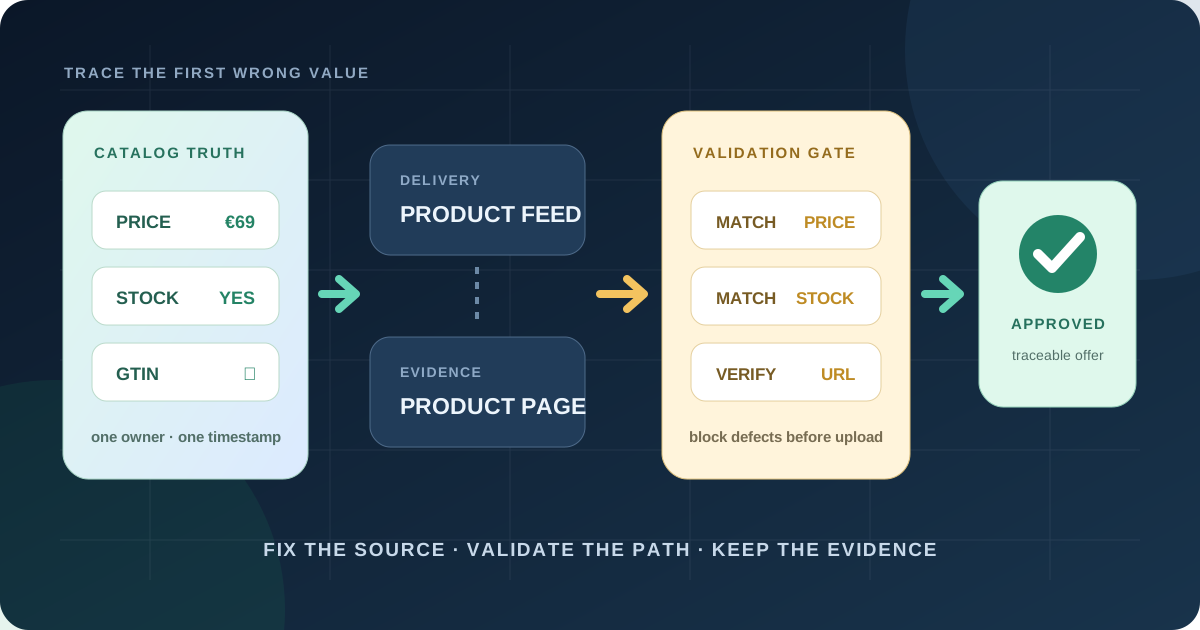
Export the affected offers, group issues by root cause, compare a representative SKU across every layer, and fix the earliest system that owns the wrong value. Use feed rules and automatic updates as controlled safeguards—not as a permanent substitute for correct catalog data.
Why a product-feed audit matters in 2026
Google changed the Merchant Center product-data specification on 14 April 2026. New product-level shipping fields include handling_cutoff_time and minimum_order_value; video_link became eligible to serve with policy and quality validation from 30 June. Google also began warning about product images below 500 × 500 pixels ahead of enforcement on 31 January 2027. These are not reasons to add every new field immediately. They are reasons to know who owns each field and whether your pipeline can change safely.
The feed is no longer used only by a paid Shopping campaign. Google says product information can support Search rich results, Images, Lens, free listings, and the Shopping tab, depending on surface and eligibility. McKinsey's June 2026 European retail report also describes retailers pushing catalogs into AI-led discovery. That broader distribution increases the cost of contradictory data: one stale availability flag can mislead a crawler, an ad system, and a customer.
Search results in Ukrainian and Russian show direct troubleshooting intent around “Merchant Center errors,” “rejected products,” “feed requirements,” and mismatched price or availability. The useful answer is operational, not another attribute glossary: create one repeatable way to find, repair, and prevent catalog defects.
Map the product-data chain before editing anything
For one offer, write down the actual path from business record to Google. A typical store has at least five representations:
| Layer | What it controls | Typical failure |
|---|---|---|
| Catalog source | SKU, variant, brand, GTIN, base attributes | Wrong owner or incomplete master data |
| Commerce state | Sellable price, stock, market, tax and promotion | Updates arrive late or use another clock |
| Feed transform | Google attributes, labels, exclusions and formatting | A rule masks, rounds, or drops a value |
| Product page | Visible offer, canonical URL and purchasability | Wrong variant, currency, redirect, or blocked crawl |
| Structured data | Machine-readable Product and Offer values | Markup disagrees with visible page or feed |
Merchant Center is an observer of this chain, not necessarily its source. A price mismatch can originate in an ERP export, promotion service, currency conversion, cache, theme, JSON-LD generator, regional URL, or feed schedule. Record the responsible owner and refresh cadence for every layer. Without that map, teams patch the closest dashboard and create two competing truths.
Keep stable offer IDs. If the same physical variant receives a new ID after every import, history, diagnostics, campaign learning, and joins become harder to interpret. Conversely, do not reuse one ID for materially different variants. Product family, sellable offer, and inventory location are different entities even when a platform flattens them into one row.
Triage by impact, scope, and repeating pattern
Start in Merchant Center's “Needs attention” view and export the complete issue set. Google distinguishes warnings from disapprovals: a warning can limit performance or later become a disapproval; a disapproved product cannot show on Google. Account-level issues can affect the entire catalog. Preserve the issue name, affected countries, programs, first-seen time, sample IDs, and current count.
Do not simply sort by the number of warnings. Prioritize in this order:
- Account and policy risk: anything that can suspend all products or misrepresent the business.
- Lost eligible demand: disapproved offers with stock, margin, and meaningful traffic potential.
- Systemic defect: one transform or template causing the same issue across a cohort.
- Upcoming enforcement: such as the 500 × 500 image requirement, while there is time for asset work.
- Enrichment: optional attributes that improve completeness but do not repair a broken offer.
Group by root-cause signature, not Google message alone. Fifty “price mismatch” rows may split into expired promotions, wrong currency URLs, delayed stock jobs, and tax display differences. Fixing one row from each cluster proves little; fixing the shared producer can recover the cohort.
Build a one-SKU truth table
Choose five to ten affected offers that represent different categories, variants, markets, and update patterns. Capture all layers at the same timestamp. Use the exact landing URL Google receives, including locale and query parameters.
Offer ID: ua-shoe-482-black-42
Observed at: 2026-09-14T08:10:00Z
Field         Catalog   Feed      Visible page   JSON-LD   Checkout
price         2899 UAH  2899 UAH  2699 UAH       2699 UAH 2699 UAH
availability  in_stock  in_stock  in_stock        in_stock in_stock
GTIN          0482...   0482...   0482...         0482...  n/a
variant       black/42  black/42  black/42        black/42 black/42
owner         pricing   feed job  storefront      SEO app  commerce
The earliest incorrect value is the repair point. In this example, the promotion reached the storefront but not the commerce export used by the feed. Editing the Merchant Center price would hide the broken synchronization and be overwritten later.
Also test the page as an unauthenticated crawler: final HTTP status, redirect chain, canonical, indexability, rendered visible price, selected variant, currency, stock state, images, structured data, shipping and returns. Google's merchant-listing documentation notes that JavaScript-generated product markup can be less reliable for fast-changing price and availability; where practical, put critical Product data in the initial HTML.
Fix six common root causes
1. Price and sale timing
Define one calculation service or record as authoritative for the sellable price by market. Align currency, tax inclusion, member pricing, minimum quantity, and promotion start/end with time zones. The landing page must make the submitted price available without requiring a coupon, login, or different variant selection unless the relevant Google attribute and policy support that condition.
2. Availability lag
Measure the delay from a stock change to page, feed, and Google submission. Fast-moving stores need event-driven or more frequent updates; a nightly file cannot honestly represent scarce stock at noon. Google recommends automatic item updates to reduce temporary mismatch, but that feature corrects Google's copy after observing the site. It does not repair overselling, a stale marketplace feed, or the underlying inventory system.
3. GTIN, brand, and variants
Use the identifier assigned to the exact trade item. Do not invent a GTIN, copy a sibling variant's code, or mark a branded product as custom merely to bypass validation. GS1 says marketplaces use Verified by GS1 to check identifiers and reduce duplicate or inaccurate catalog records. Preserve distinct color, size, pack count, and model values consistently across title, variant URL, feed, and structured data.
4. Images
Audit the original asset, not only its resized page rendition. Remove promotional overlays, placeholders, broken CDN signatures, and URLs blocked to Google. Create a report of every primary and additional image below 500 × 500 now; Google's announced enforcement begins 31 January 2027. Treat Google's image optimization as a fallback, not an asset-production strategy.
5. Shipping, returns, and market rules
Compare account-level settings, product-level overrides, landing-page promises, and checkout reality for each target country. Model cutoff time, minimum order value, delivery service, handling time, return window, and exclusions with owners and effective dates. Do not publish a new 2026 shipping attribute until the source can maintain it correctly.
6. Landing page, crawl, and policy
The submitted URL should resolve to the exact purchasable offer. Remove redirects to categories or another market, accidental authentication, robots blocks, unavailable resources, placeholder copy, and contradictory business details. Technical validity does not override Shopping policies. If an account or product was rejected for a policy reason, understand and fix that policy issue before requesting review; repeated speculative appeals waste limited review opportunities.
Add controls before the next catalog change
Create a contract for the fields that make an offer sellable. Validate it before publishing:
- unique, stable offer ID and exact variant mapping;
- valid landing and image URLs on the public host;
- currency, decimal, tax, stock, and sale-date consistency;
- required identifiers present only when genuine;
- feed price and availability equal to rendered page and structured data;
- shipping and return promises compatible with checkout;
- expected item count and change volume within a safe range.
Fail the release on material errors. Quarantine only the affected cohort when safe, so one malformed category does not remove the whole catalog. Store the produced feed, source version, validation report, and transformation version for each run. Alert on sudden changes in offer count, rejection rate, price distribution, missing images, refresh age, and time from source update to acceptance.
Use supplemental feeds or rules for deliberate channel-specific enrichment such as campaign labels. Do not use them to conceal errors in identifiers, price, stock, or core product facts. Every rule needs an owner, reason, test, and expiry review.
A seven-day Merchant Center repair plan
Take a before snapshot. Release one cause group at a time and wait for processing evidence rather than changing unrelated values repeatedly. For a formal product review, Google says processing commonly takes three to five business days and can take longer; its issue-resolution page describes other rescans that often complete in 24–48 hours. Treat interface estimates as current guidance, not a guaranteed SLA.
Measure catalog health, not only “approved”
Track eligible and approved offers by country and program; disapproval and warning rates by cause; revenue-bearing offers affected; feed freshness; page/feed mismatch rate from your own probes; time to detect, repair, submit, and recover; repeat defects within 30 days; and the share of fixes made in the owning source rather than manually.
An approved offer can still be poor. Sample titles, images, variants, delivery promises, and destination pages for accuracy and usefulness. Compare clicks and conversion after controlled improvements, but do not attribute every movement to one feed edit: bidding, competition, seasonality, demand, site quality, and policy eligibility also matter.
Frequently asked questions
Why are products rejected in Google Merchant Center?
Common causes include missing or invalid attributes, price or availability disagreement, incorrect identifiers, inaccessible or inconsistent landing pages, image problems, market configuration, and Shopping-policy violations. Diagnose the exact affected scope before editing.
Should I fix an error directly in Merchant Center?
Only if Merchant Center is intentionally the owning source. Otherwise repair the CMS, ERP, PIM, pricing service, feed transform, or page template that produced the wrong value; a direct edit may be overwritten.
Do automatic item updates replace a correct feed?
No. They can reduce temporary price and availability mismatch by using page data. They do not repair catalog ownership, other channels, checkout, identifiers, or policy problems.
How often should a product feed update?
Often enough to stay truthful for the fastest-changing critical field. A stable catalog may tolerate daily refreshes; scarce inventory or frequent promotions may need event-driven or API updates plus monitoring.
What changed in the 2026 Merchant Center specification?
Google added shipping-related fields and a video-link field, began video serving and quality checks on 30 June 2026, and started warnings ahead of a 500 × 500 minimum image resolution taking effect on 31 January 2027.
Sources and verification date
Verified 14 September 2026 against Google's 2026 Merchant Center specification update, Merchant Center issue guidance, product-data specification, and Google Search ecommerce documentation; GS1's marketplace identifier guidance; and McKinsey's June 2026 European retail report. Requirements, interface labels, review timing, and eligibility can change; verify the current account guidance before acting.
Rendframe can trace a catalog from ERP or CMS to feed, page, schema, and checkout; repair the integration; and add release tests that stop regressions. Review the inventory-sync system, use the AI-shopping readiness audit, or send us an anonymized issue export and one product URL.