A lead is not a CRM record. It is a person who has started a conversation, often in a channel the sales team does not watch consistently. The useful automation is not a chatbot that promises instant replies. It is a controlled route that captures context, rejects junk, assigns accountable ownership, and proves what happened next.
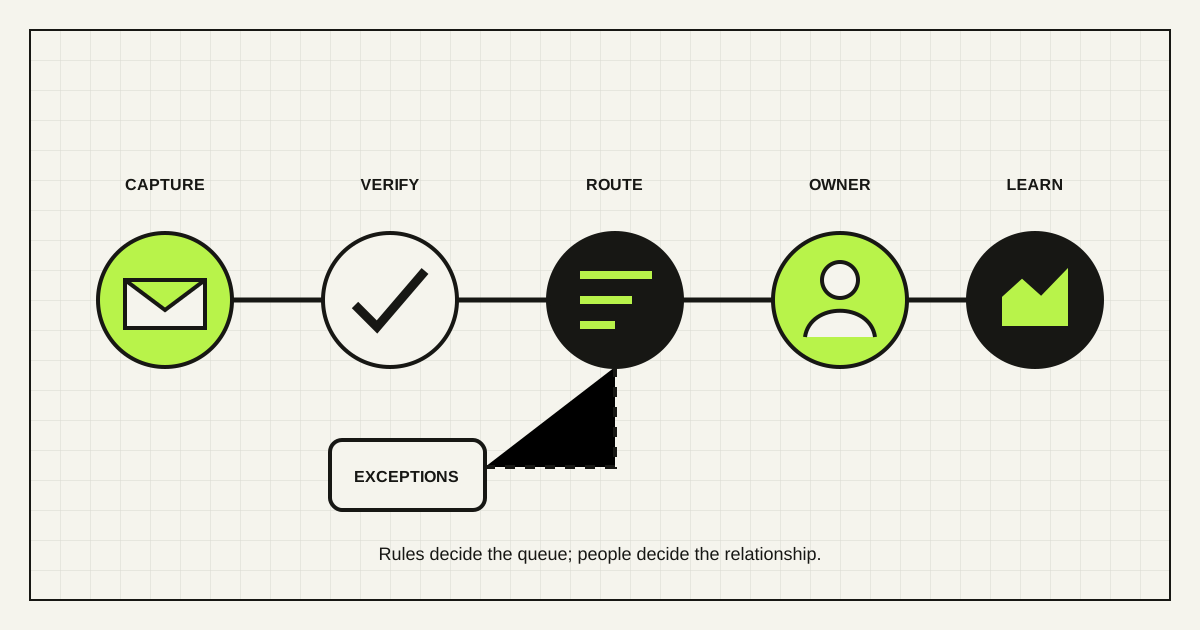
Build lead automation as a service-level system: every valid enquiry gets a durable ID, a clear owner, a next-action deadline, and an auditable outcome. That is more valuable than asking AI to guess which prospects are “hot.”
The real problem is handoff, not capture
Most teams can collect a form. Loss occurs between a website, ad lead form, email, call, Telegram, WhatsApp, Instagram, or partner referral and the person who can help. A record may arrive without source, campaign, consent, language, service requested, or a reliable way to reply. It may be copied twice, assigned to an unavailable person, or receive a generic answer that ignores its context.
McKinsey’s 2025 State of AI survey reports regular generative-AI use most often in marketing and sales, product and service development, service operations, and software engineering. It also cautions against treating adoption as enterprise value: more than 80% of respondents did not report tangible enterprise-level EBIT impact. The practical inference is simple: connect AI to a measurable operational bottleneck before expanding it.
Map every entry point before choosing software
Take 30–50 recent enquiries and reconstruct their path. Note channel, received time, identity details, consent, source and UTM data, language, requested service, first meaningful response, owner, appointment or deal, and final outcome. Include spam, duplicates, existing customers, job candidates, vendor pitches, and messages with no clear request. These are not edge cases; they define the routing policy.
Create one canonical lead object. Keep raw channel data unchanged, then add normalized fields: contact method, organisation, country or time zone when voluntarily supplied, interest, urgency, source, consent state, owner, status, next-action time, and evidence links. Do not overwrite the original message with an AI summary. A future reviewer needs both.
The controlled lead route
| Stage | Automation may do | Control |
|---|---|---|
| Capture | Ingest approved forms, inboxes and APIs | Preserve source, time and channel ID |
| Validate | Normalize fields, detect duplicates, check consent | Keep raw values and reason codes |
| Classify | Propose language, intent and service line | Use a fixed taxonomy; expose uncertainty |
| Route | Assign by territory, skill, capacity and schedule | Named fallback and escalation deadline |
| Assist | Draft acknowledgement or briefing | No invented price, promise or policy |
| Learn | Report queue health and outcomes | Audit overrides and policy versions |
Make routing deterministic where it should be: language, business hours, region, product line, existing account owner, capacity cap, and conflict rules. An AI classifier is useful for unstructured text, but its output should be a proposed label with confidence and a route to an exception queue. It should not decide whether a prospect deserves a reply.
Every assignment needs a service-level rule. Example: if the owner does not acknowledge within the defined window, notify the backup; if neither acts, put the request into an actively monitored escalation queue. “Assigned” is not the same as “responded.”
Use AI for preparation, not unsupported commitments
A model can summarize a long enquiry, translate it for the team, identify likely service intent, remove obvious spam, and draft a response from approved facts. Keep its authority narrow. It must not invent availability, quote a price without approved data, update consent, delete a record, or send a message externally without the policy your business accepts.
External messages are untrusted input. OWASP’s prompt-injection guidance describes how content can try to redirect an LLM application. Treat lead text as data, not instructions. Isolate the model from credentials; validate structured outputs server-side; use allow-listed CRM actions; redact sensitive fields in logs; and show a human the source when a classification affects routing or a reply. This protects both revenue and customer trust.
Measure the queue, not the demo
Track volume and response performance by channel, language, source, owner and time of day. Pair median response time with the 90th percentile, because averages hide abandoned weekends and handoffs. Track valid-lead rate, duplicate rate, unassigned queue age, first meaningful response, meeting rate, qualified-opportunity rate, conversion and source quality. Review AI suggestions separately: acceptance, override, false routing, and harmful drafts.
Do not claim an uplift without a baseline. Google’s research on business messaging recommends monitoring customer satisfaction, cost per sale and cost per lead; use those alongside your own CRM outcomes. Response speed alone can create a polished but unhelpful auto-reply. The goal is an appropriate conversation and a reliable next step.
A 30-day pilot
Begin with a bounded channel, a clear owner group, and no autonomous outbound communication. Test duplicates, mixed languages, out-of-hours messages, existing accounts, consent gaps, spam, unavailable owners, and ambiguous requests. Release only when every valid lead has a recorded route, exceptions are visible, and staff can safely correct a decision.
Frequently asked questions
Can AI qualify leads automatically?
It can propose structured labels and a next queue. Business-defined rules and accountable people should control consequential responses, pricing, exclusions, and relationship ownership.
Should every lead receive an instant AI reply?
No. A fast acknowledgement is useful only when it accurately sets expectations and a real follow-up is reliably owned. Start with internal routing if your response policy is not ready.
What is the first metric to improve?
Measure unassigned or overdue valid leads first. That makes the operational leak visible before you optimize conversion rates.
Sources and verification date
Verified 8 September 2026 against McKinsey’s State of AI 2025, Google’s business messaging research, and OWASP’s prompt-injection guidance. Outcomes vary by source mix, sales process and implementation.
Rendframe can audit lead intake, connect channels to your CRM, define routing and approval rules, and build a measurable pilot. Explore business AI automation or send us an anonymised lead-flow diagram.