Overselling is rarely caused by one bad number. It happens when several systems are each locally correct and globally inconsistent: the warehouse counts ten units, the store still exposes eight, a marketplace has not received the last sale, two checkouts reserve the final unit, and a cancelled order releases stock twice.
The problem becomes more important as commerce adds marketplaces, stores, fulfilment partners, product feeds, and AI shopping interfaces. McKinsey's June 2026 European retail research argues that AI value depends on end-to-end workflows and data foundations; analytical AI can improve forecasting and availability, but isolated use cases do not fix the operating model. Stock accuracy is one of those foundations.
This guide shows how to design a practical inventory-sync system for a growing retailer. It is platform-neutral, with current Shopify and Google examples where their documented behavior is useful.
The short answer
Choose one authoritative system for each inventory quantity. Track physical stock separately from what can be sold. Reserve stock atomically before confirming an order. Give every change a unique event ID and an expected previous version. Publish the resulting available quantity to channels, retry safely, and record acknowledgements. Reconcile each channel against the source of truth on a schedule, then route mismatches to an owner with a deadline.
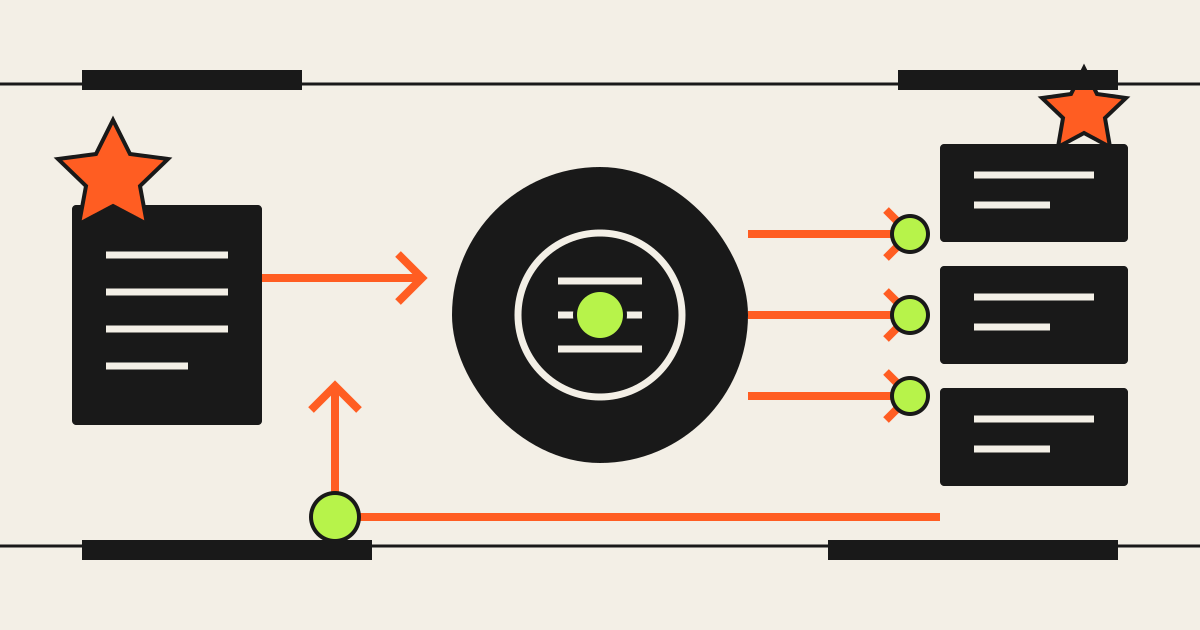
The loop is: observe → validate → reserve or release → commit → publish → acknowledge → reconcile. “Real time” is useful, but convergence after failure is the real requirement.
Do not use one field called stock
A sellable quantity is a calculation, not a warehouse count. Define the states before integrating channels:
Adjust the formula to the business, but keep the terms explicit. Incoming units are not available unless the commercial promise supports preorder. Damaged or quarantined goods are not sellable. A transfer may reduce availability at one location before increasing it at another. A bundle consumes multiple components even when the storefront shows one product.
Shopify's current inventory model separates states including on_hand, available, committed, reserved, damaged, safety_stock, and quality_control. Its documentation defines available as inventory the merchant can sell. Other platforms use different names; the important point is to map their states rather than forcing every value into one generic field.
| State | Created by | Released or changed by | Typical failure |
|---|---|---|---|
| On hand | Receipt, count, return inspection | Shipment, damage, correction | Late or duplicate count |
| Reservation | Checkout or order intake | Expiry, cancellation, commitment | Orphaned hold |
| Committed | Accepted order | Fulfilment or cancellation | Order and stock disagree |
| Safety stock | Inventory policy | Policy revision | Different buffers by channel |
| Quality hold | Warehouse or QA | Inspection | Held goods return to sale too early |
Choose one authority—and define who may write
A source of truth is not simply the database with the largest SKU table. It is the system authorized to decide a particular quantity. A warehouse management system may own physical stock, while an order-management service owns reservations and computes available-to-sell. A marketplace can temporarily own fulfilment stock stored in its network. Document authority by location, stock state, and product type.
Use stable keys: variant or SKU, location, stock state, and version. A display product ID is rarely enough. Map bundles, kits, multipacks, supplier aliases, and marketplace offer IDs explicitly. Reject an unknown mapping instead of silently writing to a plausible SKU.
Only an authoritative writer should set an absolute quantity. Shopify's current inventorySetQuantities documentation makes this distinction directly: the absolute set operation is intended for a system acting as source of truth; other integrations should consider adjustments. This is a useful general rule even outside Shopify.
Design the reservation lifecycle before the sync
Publishing stock faster will not prevent two concurrent checkouts from claiming the final unit. The decisive operation happens at order intake.
- Validate: resolve the sellable variant, location or fulfilment group, required components, and current version.
- Reserve: reduce available stock and create a reservation in one atomic transaction. If the expected quantity or version changed, fail and re-read.
- Expire: release unpaid or abandoned reservations after a documented window. The payment provider and commerce platform must agree about late payment behavior.
- Commit: convert the reservation when the order becomes accepted. Do not subtract the same units again if the reservation already reduced availability.
- Fulfil: move committed units out of physical stock when the shipment event defined by the business occurs.
- Release or return: cancellation releases the correct state once. A return becomes sellable only after the required inspection.
Define partial payment, split fulfilment, substitutions, manual orders, offline sales, preorder, backorder, and cash-on-delivery explicitly. They are not edge cases in many Ukrainian and regional commerce operations.
Make every update safe to retry
Networks time out after a receiver has applied an update. Webhooks arrive twice. Queues reorder messages. A support agent edits stock while an import is running. The integration must assume these events.
- Idempotency: assign a stable operation ID. Replaying the same event must not subtract or release stock twice.
- Optimistic concurrency: include the quantity or version the writer read. Reject stale updates and recalculate.
- Monotonic versions: store an authority sequence or timestamp so an older channel message cannot overwrite a newer state.
- Audit record: keep reason, actor, source order, location, previous value, new value, operation ID, and time.
- Dead-letter path: after bounded retries, move the event to a visible exception queue rather than discarding it.
Shopify's absolute inventory mutation supports compare-and-set: an update succeeds only when the persisted quantity matches compareQuantity, unless that protection is deliberately disabled. Shopify warns that ignoring the comparison can make quantities inaccurate under concurrent requests. That is platform documentation, but the concurrency lesson is general.
Decide whether an integration publishes absolute state or deltas. Deltas preserve individual operations but are vulnerable to missing or duplicate events unless idempotency is strong. Absolute snapshots can repair drift but may overwrite a newer state without version checks. Many reliable systems use events for speed and versioned snapshots for recovery.
Channel sync is a promise with a delay
For every channel, measure four moments: authority changed, message sent, channel acknowledged, customer-facing quantity observed. The last one matters. A marketplace can accept an API request before its storefront changes.
Set a service objective by channel and inventory risk. A fast-moving item with two units needs a different buffer from a made-to-order item. Reduce the published quantity with a safety buffer when a channel is slow or cannot reserve against the authority. Stop sales or switch to manual confirmation when updates exceed the stale threshold.
Do not forget product feeds and structured data. Google Merchant Center documents that availability mismatches often come from the time difference between website and product-data updates, and recommends coordinating updates or using automatic item updates when frequent changes make that difficult. The landing page, JSON-LD, feed, ads, and checkout should not describe different realities.
Accurate availability also supports AI-shopping readiness. An agent that discovers a product still depends on the merchant's final availability and fulfilment truth.
Event-driven does not remove reconciliation
Run a periodic comparison by variant, location, and state. Read the authority and each channel, normalize their semantics, and classify the difference. Do not merely overwrite everything every night: that can hide a repeating mapping or reservation defect.
| Mismatch | First evidence | Owner |
|---|---|---|
| Channel higher than authority | Last accepted version, queued updates, safety buffer | Integration operations |
| Authority below physical count | Open commitments, receipts, returns, cycle count | Warehouse / inventory control |
| Reservation never released | Payment and expiry events, order state | Commerce / payments |
| One SKU repeatedly drifts | Mapping, bundle components, manual edits | Catalog / integration |
| Feed differs from site | Feed generation and cache timestamps | Growth engineering |
Automatic correction is appropriate only when authority and transformation are unambiguous. Otherwise quarantine the SKU, reduce sellable stock, and ask for review. Record the correction as a new event; never edit history.
Where AI helps—and where it does not
AI can forecast demand, recommend safety-stock bands, cluster exception patterns, spot unusual manual adjustments, and prioritize mismatches by likely customer or margin impact. McKinsey's 2026 retail work links analytical AI with forecasting and product availability, while emphasizing end-to-end operating models and data foundations.
AI should not invent an available quantity or bypass the transaction that creates a reservation. A probabilistic anomaly score can open an investigation; it should not become the accounting record. Keep deterministic stock transitions, permissions, and audit logs underneath the model.
Run inventory sync as an operational product
- Oversold order lines per 1,000 accepted order lines.
- Reservation failures, expiries, and orphaned reservations.
- Channel propagation time at median and tail percentiles.
- Percentage of variants reconciled without mismatch.
- Units and value of drift by location and cause.
- Events retried, duplicated, rejected as stale, or sent to exception handling.
- Manual stock corrections and time to resolve a high-risk mismatch.
Add commercial guardrails: cancelled orders, support contacts, lost sales from conservative buffers, and conversion after an out-of-stock message. A system can eliminate overselling by hiding too much inventory; that is not success.
A 30-day rollout
Pilot with a bounded catalog and one location or channel. Simulate duplicate delivery, out-of-order updates, receiver timeout, late cancellation, manual adjustment, and a failed bundle component. A happy-path demo is not a stock-control test.
Honest limitations
No integration makes independent channels perfectly simultaneous. Marketplace caches and fulfilment networks impose external delay. Physical counts can be wrong. Safety stock trades sales for reliability. Preorders and made-to-order products need different promises. Multi-location routing may change after checkout. Define the tolerance and customer recovery policy rather than promising impossible zero drift.
Returns are another state transition, not a shortcut back to available stock. Connect inspection and disposition to the returns root-cause system.
Frequently asked questions
What causes ecommerce overselling?
Common causes include delayed channel updates, concurrent checkouts, duplicate or lost events, stale absolute writes, incorrect SKU mappings, orphaned reservations, and physical-count errors.
What should be the inventory source of truth?
The system authorized to decide that quantity for the location and state. Physical stock, reservations, marketplace-fulfilled stock, and available-to-sell may have different authorities.
Do we need real-time inventory sync?
You need latency appropriate to the stock risk plus a way to converge after failure. Event updates are useful, but scheduled reconciliation remains necessary.
Should inventory updates use absolute values or deltas?
Either can work. Deltas require strong idempotency; absolute values require authority and version checks. A common pattern uses events for speed and versioned snapshots for repair.
Can AI prevent overselling?
AI can improve forecasts, buffers, anomaly detection, and exception priority. Deterministic reservations, permissions, concurrency control, and reconciliation still protect the quantity.
Sources and review date
Reviewed 23 August 2026 against McKinsey and EuroCommerce's 2026 European retail AI report and McKinsey's distribution supply-chain analysis; Shopify's current inventory states documentation and compare-and-set inventory mutation; and Google's Merchant Center availability-mismatch guidance. Verify current APIs and channel contracts before implementation.
Continue: exclude unavailable stock from recommendations, govern the catalog identifiers and attributes, or build a resilient commerce integration with Rendframe.